Thursday, August 4, 2011

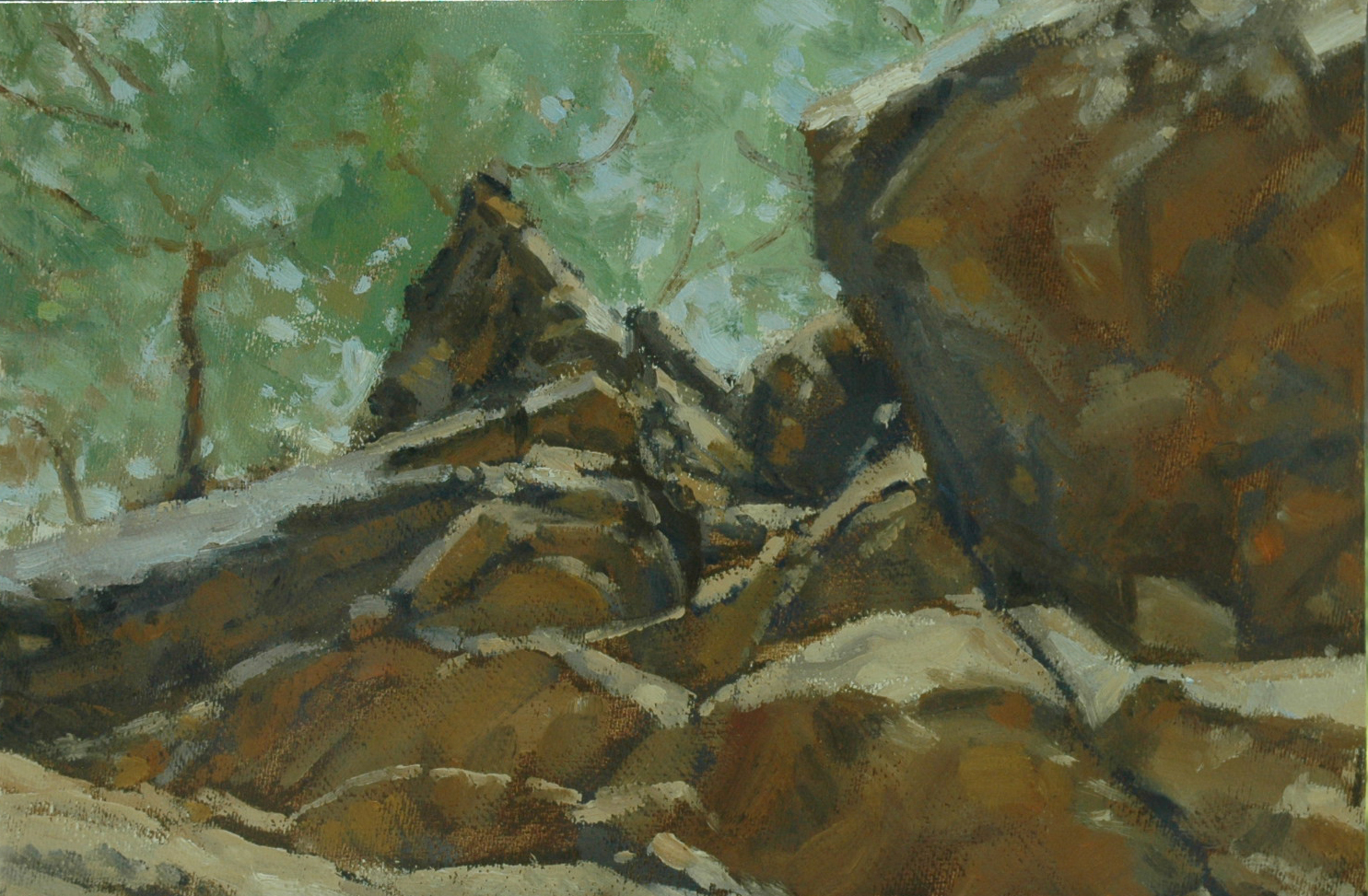
Shade
  oil on panel  8" x 11"
Donald Hall, in his marvelous book,"Life Work", asks 80 year old Henry Moore what Moore thought the secret of life is. Moore, at the height of his fame as perhaps the greatest sculptor of the 20th century, had remained a humble man who avoided any interruption to his work that he possibly could. 
At this point I'll quote directly from the book.
'With anyone else the answer would have begun with an ironic laugh, but Henry Moore answered me straight: "the secret to life is to have a task, something you devote your entire life to, something you bring everything to, every minute of the day for your whole life.  And the most important thing is - it must be something you cannot possibly do!".
Wow - something you cannot possibly do as the center of one's waking moments, the focus of all one attempts. Pretty daunting at its face value but what Henry Moore was getting at is really something joyful and enchanting - the idea that happiness or satisfaction for a lifetime is found in the work of making art - of complete engagement in coming to terms with the swirling visual world as one discovers it each day. The impossible task of compressing time and space and light into tangible evidence that might mark the way for someone else to experience that  journey - and thereby to make their own discoveries. So here's a moment on a blistering day that I found under a huge old oak tree that sits just outside my studio. Perhaps just a marker along my time spent in a small way along the path Henry describing.

Sunday, July 24, 2011

Frontal Rocks
  oil on panel  6" x 8"
Tens of thousands of years of geological time staring me face to face. Sort of puts one's cares in perspective. The earth endures and is indifferent to us and our tiny slice of time. Maybe that is one of the reasons I'm captured so, to try and come to grips with its majesty and complexity and massiveness and leave a humble visual record as an offering. 

Saturday, July 23, 2011

Morning Rocks

Morning Rocks
 oil on canvas  28" x 38"
It seems to me that, in order to make paintings that might be considered visually powerful or at least effective, a painter must be a functioning split personality. The French poet, Paul Valery, knew Degas late in the master’s life and paraphrased a key piece of knowledge passed along from the old man.“True seeing is the forgetting the names of the objects seen.”   
Every painter must discover this to be true at some point or the work can never progress beyond imitation or illustration - and into the realm of art - making. 
 Lately I have been reading two books that relate first hand stories about Cezanne and his working methods. In a synopsis of many conversations related by Joachim Gasquet, a friend of Cezanne’s since childhood and a writer and poet, Cezanne speaks of his approach to the complexity of the visual world. While Degas and Cezanne are so different in personality, life style, and artistic approach - they both have come to similar conclusions.
    “Nature is always the same, yet nothing we see endures. Our art must convey a glimmer of her endurance with the elements, the appearance of all her changes. I pick her tonalities, her colors, her nuances,... they become objects, rocks, trees, without my thinking about them,... if I get carried away with theory, if I intervene, then bang! All is lost; everything goes to hell”

     This is a wonderful explanation of the act of painting, but Cezanne was such a complex man, sometimes seeming to be contradictory about every aspect of his art, it can be confusing to read him. He admonished young artists to think and consider cylinders and spheres and cubes within the subject - this was often misinterpreted - but if you read carefully a division of when to ‘intervene’ with thinking and when not to becomes clear. Preliminary to the act of painting one must stop and think; “Why have I chosen this subject? What have I fallen in love with? Where is the poetry found in this ‘motif’?”  Then the artist forgets what the thing-ness of his subject and proceeds. A split personality in action, eh?  
Yet thinking is essential to color and influence the subsequent immersion in the act of painting. The thing that writers who knew him seem to agree on was this; Cezanne was driven every day to paint and struggle with the difficulties of being this simultaneous dichotomy - one who thinks and feels and fights to record the impossible beauty of his world, The idea that there were no contours explaining 'things' - only elements that danced, ever always changing before him - this was his obsession.  Presented here, 'Morning Rocks',  is my latest attempt to follow, in my own way, the same path. Enjoy!

Sunday, July 17, 2011

Talisman

Talisman
  oil on gessoed watercolor paper  12" x 16"

krackle 1
  oil on canvas  12" x 14"

I have a wonderful book on Degas that has really good reproductions of his work, including many drawings and studies one seldom sees in museum displays. The best part of this book, however captivating the work is, are the many letters of his and published remembrances of him by others that knew him at all periods of his life but especially in his advanced years. One of those remembrances concerns a time when Degas and a friend "slipped in to a private exhibit that his idol, Ingres, was holding in his studio for potential buyers and others of note in Parisian society. I think probably Degas use of 'slipped in' meant he and his companion crashed the party - but he worshipped Ingres and his work so I'm sure Degas felt it was justified.
Degas describes the people at the party as remarking on each work Ingres had hung for exhibit - enthusing over how 'the master' had evoked past styles and examples. Degas describes Ingres as quietly and with some discomfort accepting the accolades as if he was tolerating a misreading for the sake of not upsetting his public. Finally someone exclaimed once again that a particular work had explored another style - Ingres simply stated, 'I have many brushes'.  Degas was said to have laughed and repeated this statement many times, thoroughly enjoying the clever remark.
What was Degas enjoying - what was Ingres getting at in his cryptic remark? I think it was a simple statement about not considering styles or end results (the things these collectors and society types were all about) - instead Ingres simply wished to follow his brushes into the exploration of the 'motif'. Tempered by the discipline of craft and technique acquired in a lifetime of immersion in line, form, shadow, and light - as well as a dedication to learning all he could from the masters who had gone before -what Ingres (and Degas after him) was after in any given work was the record of the complex process of reacting to the chosen subject. After all, it was Degas who replied to an elderly matron who asked him if he had lost his mind - "what good is my mind? I have my model, my pencils, my paper, my paints - what do I need with my mind?". 
So here I'm offering two different works - a cliff of rocks from a few years back and a more recent abstraction. They are as different as two works by the same hand might be and yet, are inextricably related by mark, color, space, surface - in fact by spirit. The rock formations and deep forests that have been my most recent obsession can be seen in these two works that have gone before - some observers have the idea that if a painter works in different styles or types, they must be a dilettante - master of none.  All I can reply to such nonsense is, 'I have many brushes' - so I am not caught-up in those concerns.

Saturday, July 9, 2011

Rocks (for C.T.)


Rocks (for C.T.)
 oil on panel  12" x 18"
               The news of Cy Twombly's passing brought my thinking about my work into sharper focus I had been dissatisfied lately - too controlled, too tight, too much dictated by subject - what one artist called the tyranny of the 'things'.  Twombly's life's work of proving gain and again that marks are just marks - paintings are first and foremost just flat surfaces with scrawls and grease and pigment on them - and yet what a visceral effect the scrawls always had on me (the viewer).  I think this effect had to do with the envy/discovery of such freedom of exploration.
               This morning's paper had a column about surfer/adventurer Laird Hamilton. Hamilton is a man who has spent a lifetime finding the bigger, further, faster - riding the heaviest waves and courting fear as one would a pretty girl. The writer, Sally Jenkins, writes of Hamilton's 'ability to resolve it (terror) into grace', his 'agility and strength, courage yet surrender' and most importantly perhaps, 'recognition and release'. Hamilton describes how he functions as 'Its not so much the vastness of the wave, it is more about the insignificance of us. When you become insignificant is when you truly begin to participate. That's when it becomes a harmonious act'. 
             The description of what Laird Hamilton does in a physical, athletic world crystallized for me what I recognize in Cy Twombly's work - a surrender of any notion of control or dominance in order to become 'a harmonious act'; allowing the real experience of living, seeing, marking our place in this world to take over from any notion that we might control or know.   The best art, it seems to me, filters life experience through one's soul and is left behind like crumbs left by children in the dark forest.
So, I will cut loose and embrace the chaos of visual life, like riding an immeasurable, vast rogue wave. This painting, then, is offered to you as one of my markers, a pathway to my record of time and marks and shapes and space.

Monday, June 27, 2011

Rocks Above #2
  oil on panel  6" x 8"
Sometimes, it seems keeping up with this blog and getting my work out in front of the public takes more time and energy than the painting. This is why, for the hand full of folks who actually look at this blog, the posting must seem irregular at best. Well, that's just the organic way it seems to play out and so be it. There are days the work doesn't progress as I'd like and others that I carry the ideas around with me to sort through and figure out.  Perhaps the patience required in following this stuff distills the readership to a selection of only the finest and truest of viewers - those folks who, if we met in real life, would be instantly in tune and good friends. Anyway, I will delude myself and believe this is true.
This little rock painting is a step in a direction that I'm hoping will lead me into a series of works, pushing closer to what I want - an intuitive melding of space, place, and light based on observation, coupled with abstracted color, brush handling, and a push/pull surface vitality. The subject for my jumping off point will be these images of rock cliffs and formations I've found in western Maryland. Maybe more tomorrow on process and progress. Hey, you six or seven viewers - leave a comment and let me know how you think about the work. After all, you are an exclusive club member!

Wednesday, June 22, 2011

Pasture Trees, June 2011
 oil on panel  9" x 12"
I don't like to examine too closely how I choose what subjects I paint. Like a hitter on a streak, I'm superstitious enough to believe talking about the streak can break the streak - and you've got to respect the streak ( see: 'Bull Durham"). The key seems to be, no matter the subject, before beginning one must stop and reflect on what has made one fall in love with this moment, this place. And the answers have to be about shadow and light, color and tone, space and form. Only then can one explore freely, knowing what targets the painting is seeking. Monet wrote once that he was not interested in the subject, only in what happens between the subject and him as he made the painting. 
That is the explanation to how I choose what subjects I paint.

Saturday, June 18, 2011

Pasture, Clarke County, Virginia
 oil on panel  9" x 12"
The clouds skidding and colliding and reforming overhead, like a high ceiling gone berserk, and the trees swaying and rustling in the breeze, with the heavy bales as anchors to hold the whole scene from tearing up and blowing away - I had to work rapidly, dropping brushes and getting paint everywhere - that is when I realized that my frantic energy and sharp attention simply had become part of the whole, compressed time there - my movements echoed the crazy, bumper car sky as I worked at my task. 
What a glorious day!

Thursday, June 2, 2011

Clearing Off
 oil on panel  9"x12"
"A minute in the world's life passes! To paint it in its reality and forget everything for that! 
To become that moment ..."  Paul Cezanne
One last small painting I just realized I had left from my recent days at Manteo. Every morning down there right on into mid-day it was overcast and windy, with smoke in the air from nearby brush fires. This particular early afternoon the day flirted with clearing and I tried to grab hold of the wind and water and sky as they buffeted a small peninsula across the harbor. Isn't that just like a crazy painter, trying to grab the wind and sky - it is just that in my quirky lifetime I have found these impossibilities are the only things that can hold my interest (that and of course, baseball and those I love). 
So on it goes, this attempt to become one with the light and space.

Tuesday, May 31, 2011

Late May, Near Charles City, Virginia
 oil on panel  12" x 18"
Just one of those days that demands attention, the clouds rolling by and the trees finally full and drooping with the weight of the rain and sun. I pulled off a side road and let the place do the work. This area along Route 5, east and south of Richmond has a great richness in open space and water edged or punctuated with great, large hardwoods and thick lines of southern pines. The entire time I was there no one came by. There is a quote by Andrew Wyeth that goes, " Time is holding its breath for an instant and for eternity. That's what I'm after - that is what I'm trying to paint."
I suppose there aren't too many painters more different from each other in approach and style as Wyeth and myself - yet none more attuned to the same feeling about the work. This whole time and space battle made by a painter is really the work of physicists married to the heart of a poet.

Thursday, May 26, 2011

Wanchese Airstream

Wanchese Airstream
 9" x 12"
"The work is the man." Edward Hopper

In a pretty busy small commercial fishing harbor, across the road from the water and warehouses and piers, sat this old beauty in a field of sand and overgrown weeds.   Edward Hopper said that "the work is the man"-  I was never quite certain about his meaning until I had it pointed out to me by a bad morning.
We had gone to paint at the fishing harbor a week or so ago. All morning it is overcast and threatening rain but we're there to paint, so I start a painting. This morning's painting is of a couple of fishing boats along side a dock, piles of stuff on the dock, buildings going off into the middle distance - all blue and slate and subdued greens with a soft gray sky. It would not come together - just kicked my rear all morning, the magic just never came. Now, almost every painting goes through a period when it seems lost but this one remained lost. After 3 hours of gray I realized why it didn't work - I wasn't in love with it - I never had a trigger to see me through the process.   Well, I was discouraged and tired and about as gray as the morning.   I'm hauling my gear back to the truck and while standing in the bed of the truck I turn and across the road is this old trailer in a field of sand and overgrown weeds. I scrape off my palette and squirt out some paint and dive in. - and I am saved! In an hour and a half I slash  and flail and forget my discouragement and disaster from the morning - I have a reason to make things happen. Once again I have to teach myself why I paint - the intensity of a visual incident. A reflective surface, the juxtaposition of shadow and light, a pattern of shapes and color that describe space and form - these are the elements of physics and time, of visual life itself, that can make the insane process of making paintings come alive. Thats what it takes for me - thats how the work describes and defines me.

Sunday, May 8, 2011

Rocks Above, Swallow Falls
  oil on panel  12" x 18"
When human frailty in the form of pain or age rears its ugly head and when the energy level is less than hoped for and the focus wanders and balks - if then, one can simply pause long enough to look up, to see the complexity of the overwhelming, fantastic visual world we are standing in - troubles and time and the anchors of our thin existence dissolve like fog before the sun.  
Why do I make these paintings? This is why.